

Countertop Organization
How to Keep Your Kitchen Cool, Clean, and Organized During Summer
Eight small changes that keep the heat, the clutter and the cleanup under control when the...
Free shipping on every order
Both methods remove fat from stock and gravy. One is free and slow, the other is fast and precise.
Short answer: a fat separator removes more fat than a spoon and keeps more of your stock, because it drains the liquid out from under the fat instead of skimming the fat off the top. A spoon is fine for a thin film on a single portion. For a full pot of stock or holiday gravy, a separator is faster, cleaner and more precise. If you have several hours, chilling the pot beats both.
All three methods rely on the same physics. Fat is less dense than stock, so it floats. Everything else is just how you get at it.
| Spoon skimming | Fat separator | Chill and lift | |
|---|---|---|---|
| Time needed | 5–10 min of active skimming | 5–10 min settling, under 1 min pouring | 4+ hours (overnight is best) |
| Fat removed | Most of the visible layer; misses the last film | Nearly all of it, if you stop pouring at the boundary | Almost all; it sets into a solid cap |
| Good stock lost | Some with every pass | Very little | Almost none |
| Equipment | A spoon or ladle | A separator jug (ours holds 1000 ml, about 4 cups) | Fridge space |
| Best for | One portion, occasional use | Family-size batches, gravy on the day | Make-ahead stock and soup |
You let the liquid settle for 5–10 minutes so the fat rises, then lift it off the surface with a spoon or ladle. It needs no equipment and works well for a small amount of surface oil. The drawbacks show up with volume: it is slow, it is inconsistent, and it is very easy to take flavorful stock along with the fat. Chasing a thin oil layer around a wide pan with a spoon is a frustrating way to spend ten minutes.
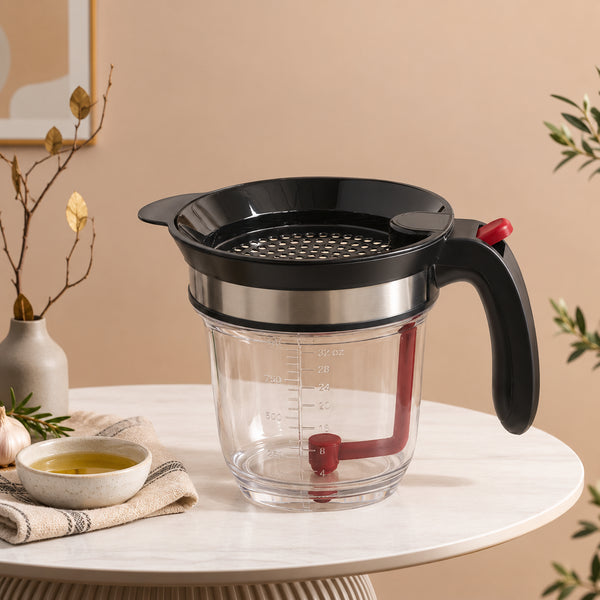
The liquid goes into a jug and settles for 5–10 minutes, so the fat collects at the top. With a bottom-release design you then drain the good stock out from underneath and stop before the fat layer reaches the outlet. The separation happens by itself. You only control when to stop pouring.
The separator, clearly. More importantly, it removes fat without removing stock. A spoon takes some liquid with every pass, and over a full pot that adds up to a noticeable loss of both volume and flavor.
Where the separator really earns its place is family-size batches: holiday gravy, a big pot of chicken stock, a soup you are making ahead. A 1000 ml bottom-release jug handles about 4 cups in one pass, so you pour the good liquid first instead of fishing oil off the top. Less skimming, fewer spills, more control over the final texture.
For a thin film on a single portion, or if you make stock twice a year, a spoon is genuinely enough. Don't buy equipment for a problem you rarely run into.
Occasional cook, small amounts: use a spoon. Regular soups, stocks and gravies, or anything family-sized: a separator is faster, cleaner and more predictable, and you keep more of what you made. Making it a day ahead: chill it and lift the cap.
For more detail, see our step-by-step guide on how to use a fat separator.
If you land on the separator side of this comparison, capacity and a bottom release are the two things that matter. This is the one we use for family-size batches.
Results are shown straight after you vote. One vote per browser.
Send your question and we'll reply by email — the good ones get added to the FAQ above so everyone benefits.
Eight small changes that keep the heat, the clutter and the cleanup under control when the...
The dirtiest spots in most kitchens are the ones nobody thinks to look at. A twelve-point...
Seven changes that make a kitchen easier to use day to day. None of them need...

