

Countertop Organization
How to Keep Your Kitchen Cool, Clean, and Organized During Summer
Eight small changes that keep the heat, the clutter and the cleanup under control when the...
Free shipping on every order
How to tell a tool that solves a real problem from a gadget that creates a new one. A buying filter, not a shopping list.
Short answer: choose kitchen tools by starting with what you actually cooked last week, buying only for a problem you can name, and checking how a tool cleans and stores before you buy it. If you won't use it at least weekly, or it takes longer to clean than it saves, skip it.
The most useful kitchen tools are rarely the most complicated ones. They are the products that quietly solve a small problem you encounter several times a week. Everything else is a gadget that needs storing, cleaning and eventually throwing away. Here is how to tell the difference before you buy.
A tool should save more effort than it costs you in cleaning and storage. If it does not, it is a net loss however clever it is.
Write down what you actually did in the kitchen last week — not what you intend to do. Reheating leftovers, washing up, making stock, keeping the counter clear. Buy for that list. Most unused gadgets were bought for an aspirational version of the cook, not the real one.
The useful purchases tend to map directly onto a recurring irritation:
If a product does not answer a problem you can name, it is not solving one.
Look for surfaces that clean easily, construction sturdy enough for daily handling, and materials rated for the heat or moisture the job actually involves. A tool that cannot take the conditions it works in will fail, and usually at the worst moment.
Pick the thing up mentally and ask how you would wash it. Does it rinse clean, or does it have seams and grooves that trap residue? Does it dry, or does it stay damp? Does it store flat, or does it need a shelf of its own? Tools that are annoying to clean stop getting used within a month.
Fix the most frustrating part of your routine first, then live with it for a few weeks before buying anything else. One well-chosen product beats five that each half-solve something. The kitchens that work best are usually the ones assembled deliberately over years.
Name the thing that annoyed you most in the kitchen this week. Buy for that, and only that. If nothing annoyed you, you do not need a new tool — which is a genuinely acceptable answer.
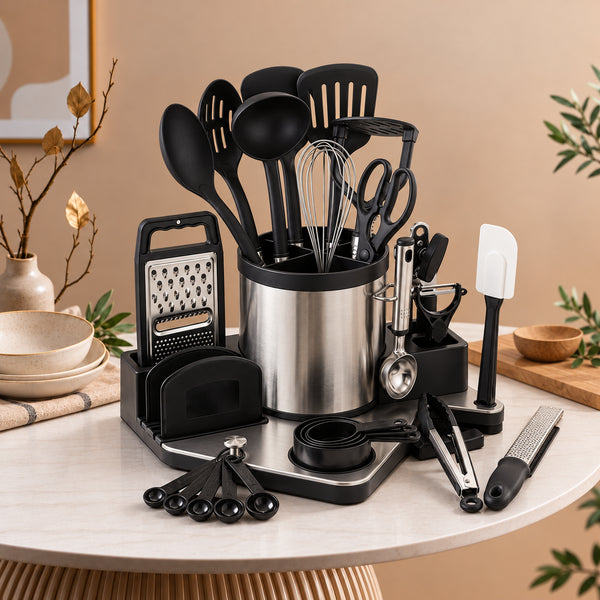
The article argues for buying few things that get daily use. Utensils are the clearest example of that — a matched set you reach for every day beats a drawer of mismatched singles.
Results are shown straight after you vote. One vote per browser.
Send your question and we'll reply by email — the good ones get added to the FAQ above so everyone benefits.
Eight small changes that keep the heat, the clutter and the cleanup under control when the...
The dirtiest spots in most kitchens are the ones nobody thinks to look at. A twelve-point...
Seven changes that make a kitchen easier to use day to day. None of them need...

